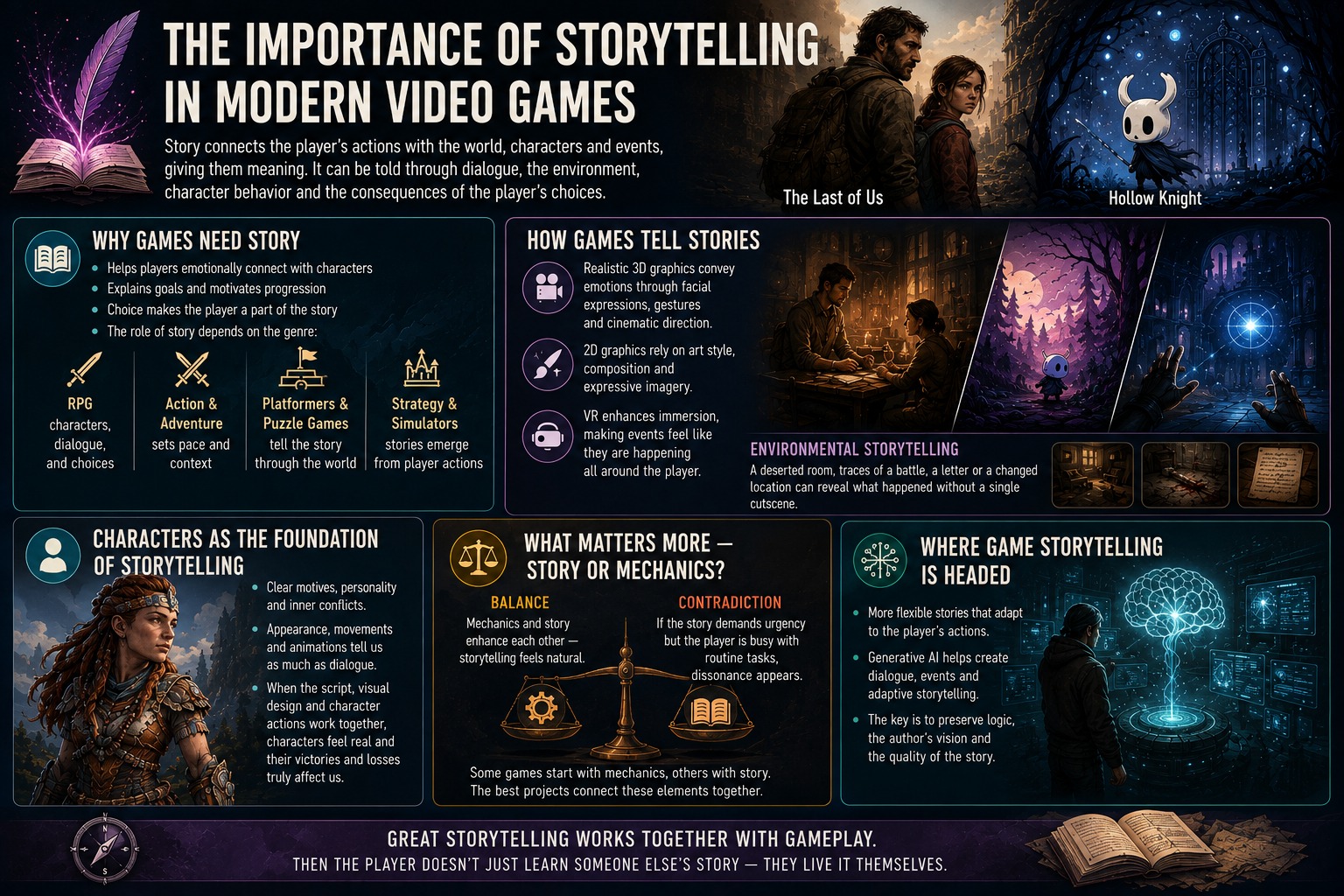
A successful game — whether a small indie project or a major AAA release — isn’t held together by mechanics alone. Story connects a player’s actions to the world, characters, and events, giving them meaning. And storytelling doesn’t have to rely on lengthy dialogue or cinematic cutscenes — it can unfold through environments, level design, character behavior, and the consequences of a player’s choices.
Great examples include The Last of Us, where character relationships take center stage, and Hollow Knight, where much of the story is revealed through exploration. In games like these, narrative isn’t separate from gameplay — it’s woven into it.
Why games need a story
Storytelling helps players form emotional connections with characters, clarifies objectives, and keeps them motivated to push forward. Even routine actions — exploring, fighting, or collecting items — feel different when players understand why they’re doing them.
Choice plays a particularly important role. When decisions shape relationships, alter specific events, or affect the ending, players feel like participants in the story rather than passive observers. This deepens immersion and often gives players a reason to replay the game entirely.
The role of narrative varies by genre. In RPGs, it typically revolves around characters, dialogue, and decision-making. In action and adventure games, story sets the pace and provides context. Platformers and puzzle games can convey entire worlds with almost no words — through visual style and level design alone. In strategy games and simulators, stories often emerge directly from the player’s own actions.
How games tell stories
Modern games draw on a wide range of storytelling tools. Realistic 3D graphics convey emotion through facial expressions, body language, and cinematic direction. 2D art relies on visual style, composition, and expressive character design. In virtual reality, there’s an added layer of presence — events feel like they’re happening around the player in real time.
Environmental storytelling is equally powerful. An abandoned room, signs of a struggle, a discovered letter, or a changed location can communicate what happened without a single cutscene. This approach works especially well in games where exploration is a core part of the experience.
Characters as the foundation of storytelling
Even the most distinctive world rarely leaves a lasting impression without compelling characters. A well-written character has clear motivations, a defined personality, and internal conflict. Appearance reinforces identity too — clothing, movement, facial expressions, and animation can say as much about a character as any line of dialogue.
When a character’s writing, visual design, and in-game actions all align, they feel real. Their victories and losses land emotionally, and players carry those moments with them long after the credits roll.
Story vs. mechanics: which matters more?
There’s no universal answer. Some projects start with a gameplay concept, then build a world and story around it. Others begin as a narrative first, with mechanics chosen specifically to highlight key story moments.
The games that resonate most are the ones where both elements complement each other. If the story calls for urgency but players are free to spend hours on optional side content, a disconnect forms. But when mechanics reinforce a character’s personality, the game’s atmosphere, and its key events, the storytelling feels natural and earned.
Where game storytelling is headed
One of the most notable developments is the push for more flexible narratives that can adapt to player behavior. Generative AI is already being explored as a tool for creating dialogue, events, and responsive storytelling — though the real challenge isn’t generating endless content, but maintaining narrative logic, authorial intent, and story quality.
Technology will keep evolving, but the core principle stays the same: great storytelling has to work hand in hand with gameplay. That’s when players don’t just watch someone else’s story unfold — they live it themselves. And that’s what makes it unforgettable.