Music in video games has long since moved beyond background noise. It sets the mood, intensifies dramatic moments, signals danger, and helps players feel more connected to what’s happening on screen. Unlike film scores, which play out on a fixed timeline, game music can respond directly to a player’s actions. That interactivity is what makes it a uniquely powerful tool.
From simple melodies to full soundtracks
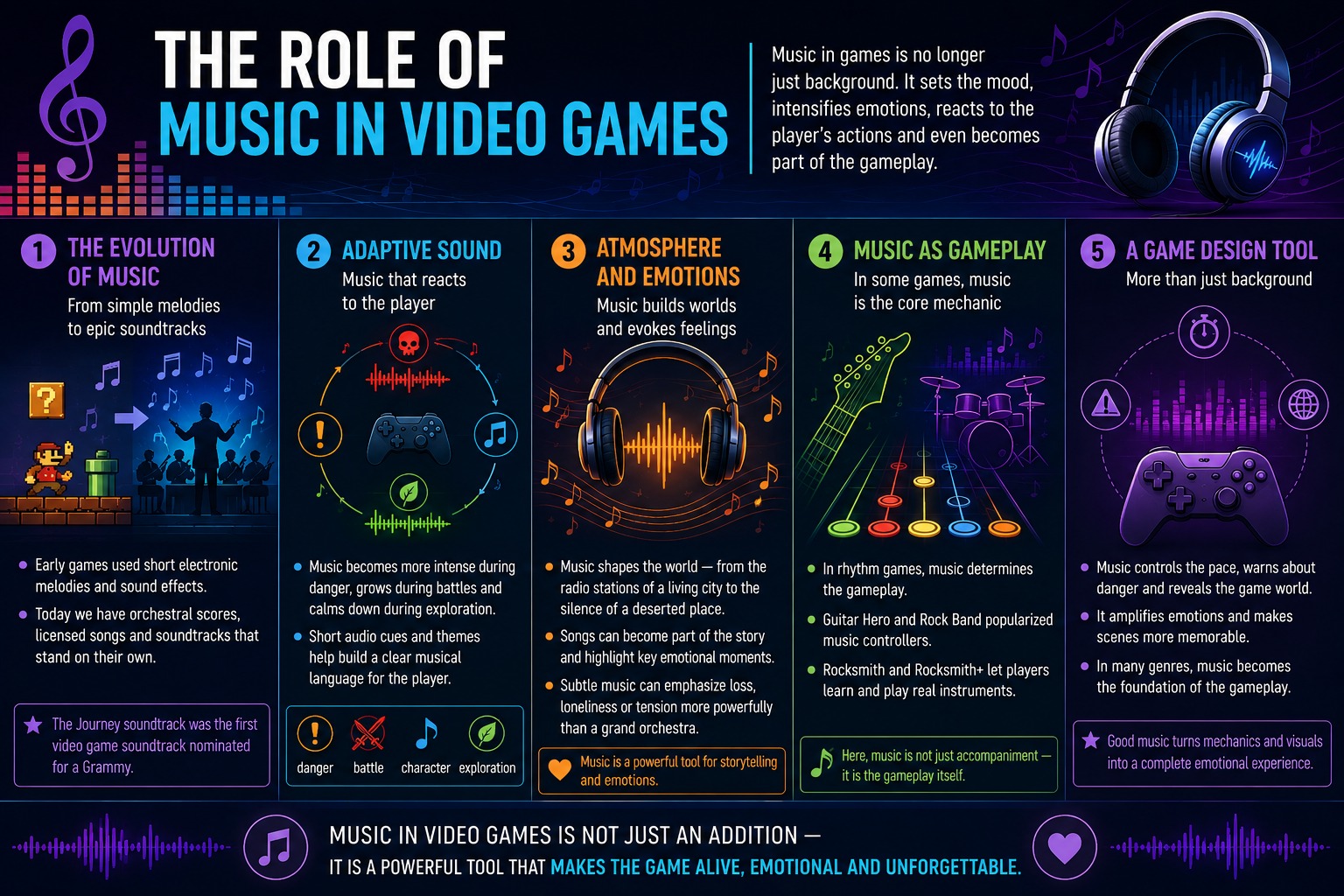
Early video games were limited by technology, so developers worked with short electronic loops and basic sound effects. Out of those constraints came a distinctive sound that we now associate with chiptune. Iconic themes from Super Mario Bros. and The Legend of Zelda have since become cornerstones of video game music history.
As technology advanced, so did the ambitions of game composers. Orchestral scores, licensed tracks, and full-length soundtracks that people listen to outside of the games themselves became the norm. Austin Wintory’s score for Journey, for example, made history as the first video game soundtrack nominated for a Grammy.
Music that responds to the player
One of the defining differences between video games and film is the ability to shift music in real time based on what’s happening. A soundtrack might grow tense as an enemy approaches, swell during combat, and settle back into something calm when the player returns to exploring. This is called adaptive or dynamic music, and it plays a key role in maintaining immersion by tying sound directly to player behavior.
Short musical cues serve a similar purpose — a victory jingle, a danger alert, or a character’s signature theme. Over time, these sounds become a musical shorthand that players intuitively understand.
Atmosphere and emotion
Music shapes the personality of a game world. The radio stations in Grand Theft Auto create the feeling of a living, breathing city while also giving players a window into its cultural identity.
Some of the most memorable moments happen when a song unexpectedly becomes part of the story. In Red Dead Redemption, Far Away by José González plays as John Marston arrives in Mexico. After hours of instrumental accompaniment, the sudden appearance of a vocal track lands with real emotional weight. Rockstar has since looked back on that moment as one of the game’s defining sequences.
Music doesn’t always need to be sweeping or grand to be effective, either. Understated, quiet scoring can communicate loss, isolation, or unease far more powerfully than a full orchestral arrangement. That’s what makes a soundtrack more than background noise — it’s a storytelling tool in its own right.
When music becomes the gameplay
In rhythm games, music isn’t just supporting the experience — it is the experience. Guitar Hero brought guitar-shaped controllers into living rooms across the country, and Rock Band expanded on that idea by letting players perform together on guitar, bass, drums, and vocals.
Rocksmith took things a step further by allowing players to plug in a real instrument instead of a plastic controller. That concept continues today with Rocksmith+, which offers structured lessons for guitar, bass, and piano with real-time feedback.
More than background noise
Great game music can be nearly invisible, yet it’s often what makes a scene truly stick with you. A soundtrack controls pacing, signals threat, builds out the world, and amplifies emotion. In some genres, it becomes the foundation of the entire experience.
That’s why music in video games isn’t decoration — it’s a core design element. It’s what transforms a collection of mechanics, visuals, and story beats into something that feels whole.